Whether you’re packaging food products, industrial components, medical supplies, or retail items, the quality of your bag seal matters. A weak or inconsistent seal can lead to product damage, contamination, moisture intrusion, and reduced shelf life.
That’s why many packaging operations rely on impulse sealing technology. Impulse sealers provide a fast, affordable, and reliable way to create airtight seals on a wide variety of plastic bags without the expense or complexity of fully automated packaging systems.
In this guide, we’ll explain how impulse sealers work, when airtight sealing is required, and how to select the right machine based on your bag material, thickness, production volume, and application.
What is an Impulse Sealer?
An impulse sealer is a type of heat sealing machine that uses a brief burst of electrical energy to heat a sealing element. When the sealing arm closes, heat is generated only during the sealing cycle, melting the layers of plastic together to create a permanent seal.
Unlike constant heat sealers, impulse sealers remain cool between cycles. This makes them energy-efficient, safer to operate, and suitable for many common thermoplastic bag materials.
Common materials that can often be sealed with impulse sealing technology include:
- Polyethylene (PE)
- Polypropylene (PP)
- Polyolefin
- Shrink bags
- Many laminated plastic materials
When is an Airtight Seal Required?
Not every package requires a hermetic seal, but many products benefit from creating a strong barrier against air, moisture, dust, or contaminants.
Food Packaging
Airtight seals help preserve product freshness and protect products from outside contamination. Bakeries, snack manufacturers, coffee roasters, and food processors frequently use impulse sealers to secure packaged goods.
Medical and Laboratory Products
Medical supplies and test components often require reliable package closure to maintain product integrity during storage and transportation.
Industrial Components
Small parts, hardware, electronics, and sensitive materials can be protected from moisture, dust, and handling damage with properly sealed bags.
Retail Packaging
A clean, professional seal improves package appearance and helps prevent tampering during shipment and display.
Benefits of Impulse Sealing Technology
Impulse sealers remain one of the most popular bag sealing solutions because they offer several advantages:
Safer Than Heat Sealing
Heat sealers require that a temperature is set on the machine and that the sealing bars are maintained at that temperature. This can cause burns to the operator. With an impulse sealer, there is only a brief burst of heat and much less chance of operator injury.
Energy Efficient
Because heat is generated only during the sealing cycle, impulse sealers consume less energy than continuous heat sealing systems.
Easy to Operate
Most machines require only a simple adjustment of the sealing timer based on the bag material and thickness. Once set, operators can consistently produce clean seals.
Reliable Seal Quality
A properly-configured impulse sealer can create strong, repeatable seals that improve packaging consistency and reduce rework.
Affordable Entry into Packaging Automation
For many operations, impulse sealers offer an economical way to improve packaging quality without investing in a fully automated packaging line.
How to Choose the Right Impulse Sealer
1. Bag Material
Different plastics require different sealing temperatures and dwell times.
Thin polyethylene bags seal quickly and easily. Heavier laminates or specialty materials may require broader seals, longer sealing times, or dual-heating systems.
When determining equipment requirements, always verify:
- Material type
- Material thickness
- Number of layers being sealed
- The thicker the material, the more sealing power is generally required.
2. Material Thickness
One of the most important specifications is bag thickness, typically measured in mils.
As bag thickness increases, stronger sealing systems become necessary.
For example:
Choosing a sealer that matches your bag thickness is essential for achieving consistent airtight seals.
3. Seal Width
Seal width affects both package appearance and seal strength.
A standard 2 mm seal is sufficient for many everyday packaging applications. Wider 5 mm seals offer greater strength and durability, making them popular for heavier bags and demanding environments.
3. Production Volume
The number of bags sealed per day often determines which machine type is most appropriate.
A small operation sealing dozens of bags each day has vastly different needs than a production facility sealing thousands.
Which Tach-It Impulse Sealer is Right for You?
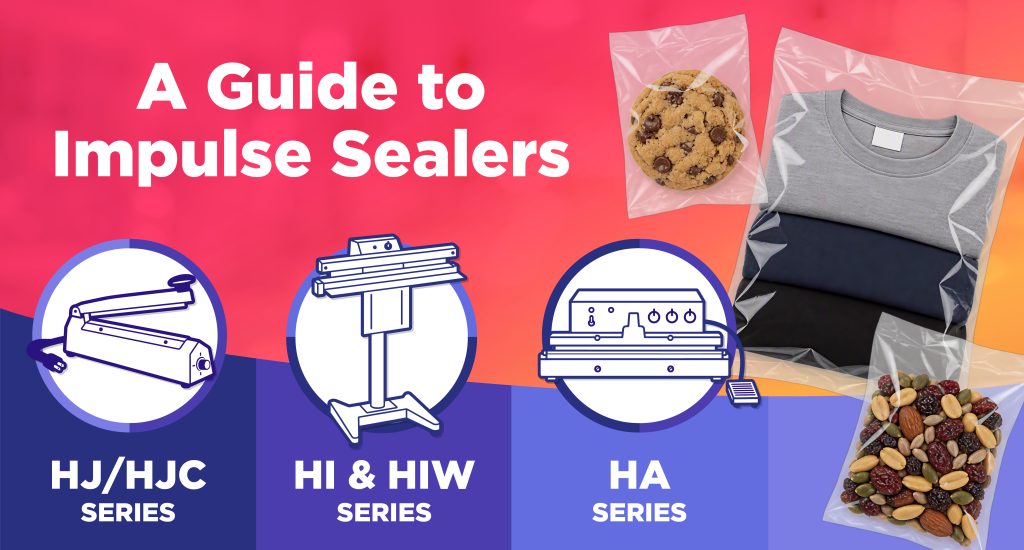
HJ and HJC Series: Best for Low-to-Medium Volume Packaging
The Tach-It HJ and HJC Series consists of compact tabletop impulse sealers designed for easy operation and minimal footprint. Models are available with seal lengths from 4 to 16 inches and seal widths of either 2 mm or 5 mm. The HJC models also include an integrated cutter that trims excess bag material above the seal for a cleaner finished package.
Best for:
- Shipping departments
- Retail packaging
- Small food production operations
- General-purpose bag sealing
HI Series: Best for Higher Production Environments
The Tach-It HI Series features self-standing foot-operated sealers that free the operator’s hands for positioning product and bags. Available in 12-, 18-, and 24-inch seal lengths, these machines are designed for increased productivity while preserving valuable workbench space.
Best for:
- Manufacturing facilities
- Distribution centers
- Food processors
- Higher-volume packaging operations
HIW Series: Best for Heavyweight Bags
When sealing thick or heavy-duty materials, the HIW Series offers a significant advantage. Unlike standard impulse sealers that heat from one side, the HIW machines apply heat from both the upper and lower jaws, enabling sealing of materials up to 20 mil thick.
Best for:
- Heavy industrial packaging
- Thick poly bags
- Multi-layer materials
- Bulk product packaging
HA Series: Best for Consistent High-Volume Sealing
The HA Series combines semi-automatic operation with a preset dwell timer and electromagnetic pressure system. This design helps eliminate operator variability, producing highly consistent seals during continuous production. Models are available in seal lengths from 14 to 24 inches and widths of 2 mm or 5 mm.
Best for:
- Repetitive production environments
- High-volume bag sealing
- Facilities requiring seal consistency
- Quality-sensitive packaging operations
Frequently Asked Questions?
What materials can be sealed with an impulse sealer?
Impulse sealers are commonly used with polyethylene, polypropylene, polyolefin, and many other thermoplastic materials.
Can impulse sealers create airtight seals?
Yes. When properly matched to the bag material and thickness, impulse sealers create strong airtight seals that help protect products from moisture, contaminants, and air intrusion.
What is the difference between a 2 mm and 5 mm seal?
A 5 mm seal provides a larger sealing surface and generally offers greater seal strength, making it a good choice for heavier bags and demanding applications.
Do thicker bags require a different type of sealer?
Often, yes. As bag thickness increases, more sealing energy and sometimes dual-sided heating are required. Heavyweight materials may be better suited for machines such as the Tach-It HIW Series.
Selecting the Right Sealer Starts with the Application
Choosing the right impulse sealer is about more than seal length alone. The ideal machine depends on your bag material, film thickness, required seal strength, and production volume.
For occasional sealing needs, a tabletop unit may be the perfect solution. For higher throughput operations or heavier materials, foot-operated and semi-automatic models can improve productivity while delivering stronger, more consistent results.
By understanding the fundamentals of impulse sealing technology, businesses can confidently select equipment that protects their products, improves package quality, and supports efficient packaging operations.